
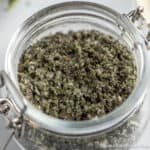
Drying Sage Leaves
Three different methods for drying fresh sage leaves.
Servings 1 batch
Calories 1kcal
Equipment
Ingredients
- 1 bunch sage leaves
Instructions
- Pick fresh sage and remove leaves from stems.
- Rinse leaves and dry with a clean towel or a salad spinner. Try to remove as much water as possible.
- Lay leaves in a single layer on a food dehydrator tray.
- Set the temperature on dehydrator to 95°F - 115°F.
- Dry until leaves are fully dried and brittle. Drying time will take between 2-4 hours. This will vary depending on your dehydrator, the number of leaves you are drying and the humidity in your area.
In the Oven
- Pick fresh sage and remove leaves from stems.
- Rinse leaves and dry with a clean towel or a salad spinner. Try to remove as much water as possible.
- Place leaves in a single layer on a baking sheet lined with a baking rack. The rack allows air to circulate under the leaves.
- Place in a very low-temperature oven, around 170°F for about 30 minutes. If your oven doesn't go any lower than 200°F, heat the oven to that temperature and then turn your oven off before placing sage leaves in the oven to dry.
Air Drying
- Pick fresh sage but do not remove leaves from stems.
- Rinse leaves and dry with a clean towel. Try to remove as much water as possible.
- Bundle the stems together with a rubber band and hang upside down in an area that has some airflow. Hang until the leaves are fully dried. Drying time will vary depending on the size of your bunch and the humidity in your area. In high-humidity areas, you'll need to monitor your sage to make certain it is drying. If the sage begins to mold, discard it and try a different method for drying.
Notes
-
- Dry any amount of sage leaves that you'd like. The more you dry, the longer the drying time may be, depending on your method of drying.
-
- Leave the leaves whole or crumble for easier storage.
-
- Dried herbs won't go bad unless they aren't fully dried and become moldy. If they become moldy, discard them.
-
- Dried herbs are best used within one year. After that, they may start to lose some of their flavor.
Nutrition
Serving: 0.25teaspoon | Calories: 1kcal